Operations & Field Service
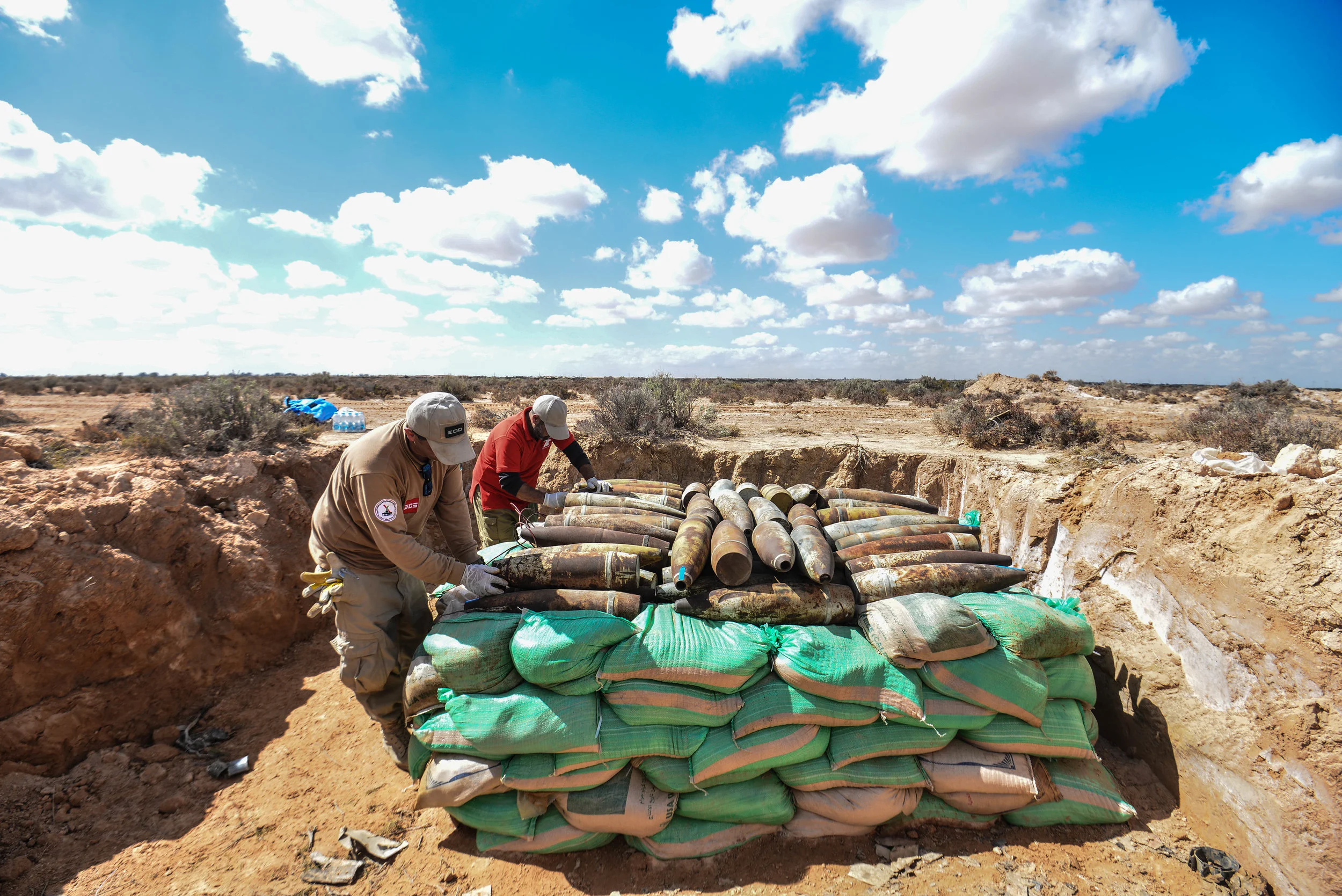
Explosive hazard reduction in post-conflict environments often continues amid ongoing political and security instability. Remaining operational in such contexts requires careful risk management, strong local partnerships and strict adherence to national and international mine action standards.
Libya is one such environment. Since mid-2018, Global Clearance Solutions (GCS) has supported humanitarian mine action and airway clearance activities in the country through the deployment of explosive ordnance disposal specialists and mechanical assets, including the GCS-100 platform, collecting UXO at Misrata airport among others.
Supporting clearance under deteriorating security conditions
Following the collapse of central authority after 2011, Libya has experienced prolonged instability and fragmented security conditions. In April 2019, while GCS was concluding a clearance project in cooperation with the local NGO Free Fields Foundation, security conditions deteriorated sharply as armed hostilities intensified in the Tripoli region.
Despite the escalation, GCS teams completed the agreed scope of work in Misrata. The project focused on the collection and disposal of explosive remnants of war, resulting in the removal of more than 200 tonnes of ERW. This significantly reduced immediate risks to the local population and limited the potential diversion of explosive material by criminal or extremist actors.
All activities were conducted with the support of the Libyan Mine Action Center (LibMAC) and in accordance with the Libyan Mine Action Standards (LibMAS), ensuring compliance with national regulatory and safety requirements.
Ongoing capacity building and field support
In parallel, GCS continued to support humanitarian mine action efforts in eastern Libya. One of its IMAS-qualified EOD experts was deployed to Benghazi to support another Free Fields Foundation project through training and operational preparation. The project aims to improve safe movement for conflict-affected populations and humanitarian organisations by identifying and removing explosive hazards in and around urban areas.
The approach reflects GCS's broader emphasis on combining technical expertise with training and local capacity development, particularly in environments where sustained clearance efforts are required over extended periods.
Managing risk responsibly
Operating in volatile environments requires continuous assessment of security conditions and close coordination with local partners. As GCS Chief Executive Officer Philipp von Michaelis explains:
"The safety of our staff is our highest priority. We closely monitor the security situation and rely on the judgement of our local partners, who are best placed to assess developments on the ground."
While temporary ceasefires have at times reduced violence, the security situation in Libya remains unpredictable. Explosive hazards continue to threaten civilians, humanitarian workers and critical infrastructure, underlining the need for sustained, carefully managed mine action activities.
GCS remains committed to supporting clearance efforts where conditions allow, contributing to risk reduction and enabling future stabilisation and recovery initiatives when the security environment permits.
Country
Libya
Publish Date
Product Segments
Operations & Field Service
Unmanned Systems (UXS)
Capabilities
Urban Clearance
Explosive Ordnance Disposal (EOD)
Battle Area Clearance
Runway/Airfield Clearance


