Unmanned Systems (UXS)
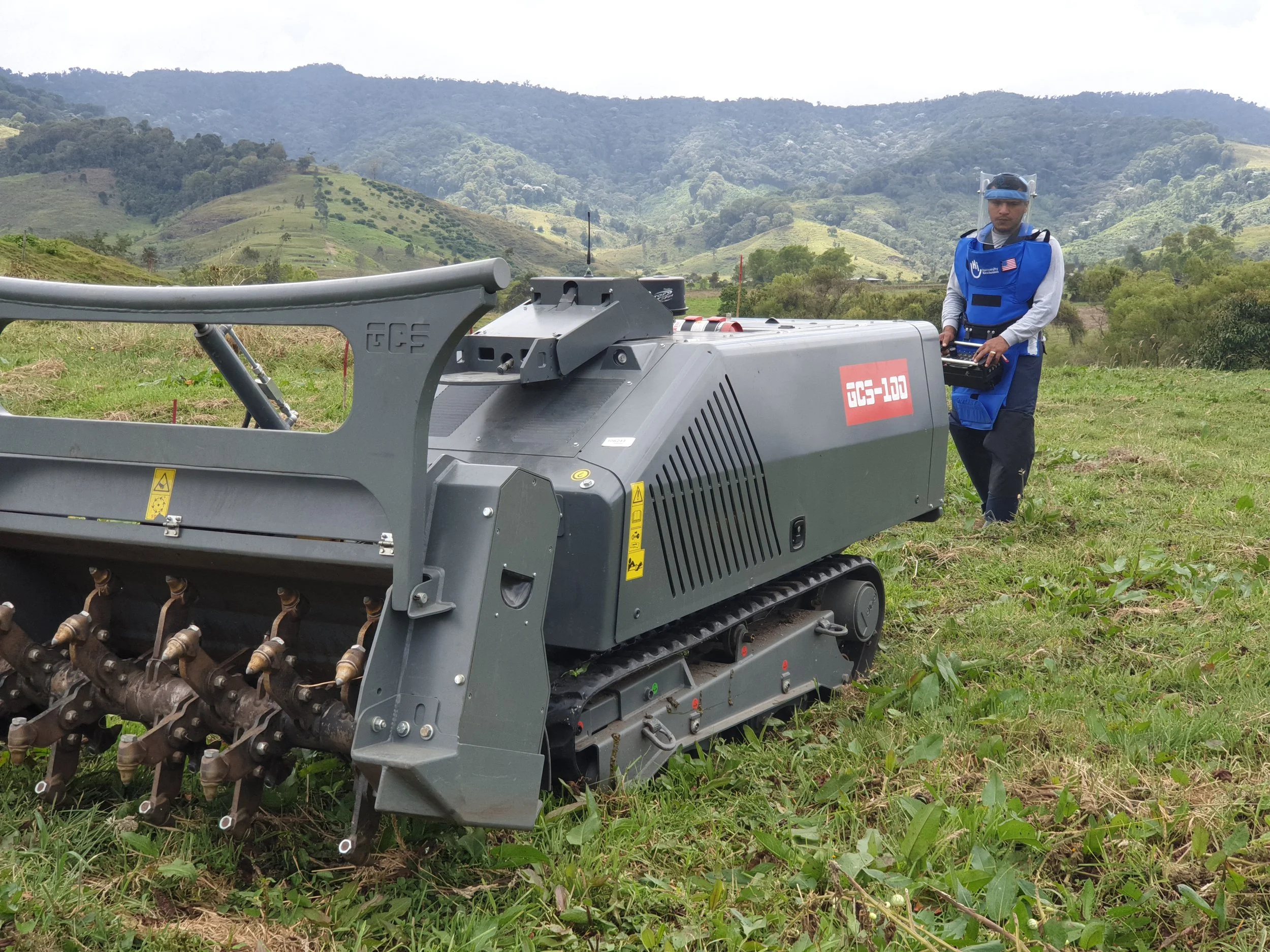
Explosive contamination in Colombia continues to restrict safe movement and access to land, particularly in rural and remote areas affected by decades of conflict. Mechanical demining has become an important component of humanitarian mine action in such environments, supporting safer and more efficient clearance when applied alongside manual methods.
On the occasion of the UN International Day for Mine Awareness and Assistance in Mine Action, Global Clearance Solutions (GCS) reflects on the operational lifecycle of one of its GCS-100 mechanical demining platforms following several years of deployment in Colombia.
Mechanical demining in a complex national context
Colombia has been affected by more than five decades of armed conflict involving state forces, non-state armed groups and criminal organisations. Landmines and other explosive hazards were widely used to control territory and restrict access, particularly in rural areas. Despite the 2016 peace agreement, explosive remnants of war and improvised devices continue to pose risks.
According to UN figures, more than 12,000 people have been injured or killed by mines and explosive hazards in Colombia since 1990. Children and rural populations remain particularly exposed, often forced to travel long distances through contaminated areas to access education or livelihoods.
The role of the GCS-100 in Colombian terrain
The GCS-100 was deployed to Colombia in 2017 to support humanitarian demining operations in terrain characterised by dense vegetation, uneven ground and limited access. Its compact dimensions and mobility made it suitable for constrained environments where larger systems cannot operate effectively.
In operation, the GCS-100 supported:
ground processing, loosening soil to typical mineburial depth to expose or neutralise hazards
ground preparation, using tillerbased tools to damage, detonate or destroy explosive items
vegetation management, reducing overgrowth while enabling followon manual clearance
Field experience showed that mechanical processing not only reduced direct exposure of deminers to risk, but also limited long-term environmental impact. Vegetation shredded and mixed back into the soil allowed faster natural regrowth compared with repeated manual clearance methods that compress and remove surface layers.
Training, operation and field support
Over several years, the GCS-100 was operated and maintained by trained personnel in Colombia, with GCS specialists supporting deployment, operator training, maintenance and bestpractice development. The platform was integrated into humanitarian clearance workflows rather than used as a standalone asset.
This approach reflects GCS's view of mechanical systems as part of a broader capability set that includes training, technical support, quality management and long-term service.
Returning to service life
In early 2022, the GCS-100 returned to GCS facilities in Germany after completing its deployment cycle in Colombia. The platform entered a structured restoration and overhaul process, enabling it to be prepared for future humanitarian demining tasks in other affected regions.
Lifecycle support is a critical but often overlooked element of mine action. Restoring and redeploying proven mechanical systems allows clearance organisations to retain capability, reduce procurement lead times and maintain operational readiness.
Continuing the mission
Mine awareness remains essential. While clearance operations reduce risk on the ground, education and visibility are key to preventing accidents in contaminated areas that have not yet been cleared.
The experience of the GCS-100 in Colombia demonstrates how mechanical demining, when combined with trained personnel, field support and long-term maintenance, can contribute meaningfully to humanitarian mine action. As clearance needs persist in Colombia and elsewhere, such integrated approaches remain vital to reducing explosive risk and enabling recovery.
Country
Colombia
Publish Date
Product Segments
Unmanned Systems (UXS)
Operations & Field Service
Capabilities
Demining (Humanitarian Mine Action)
Battle Area Clearance


