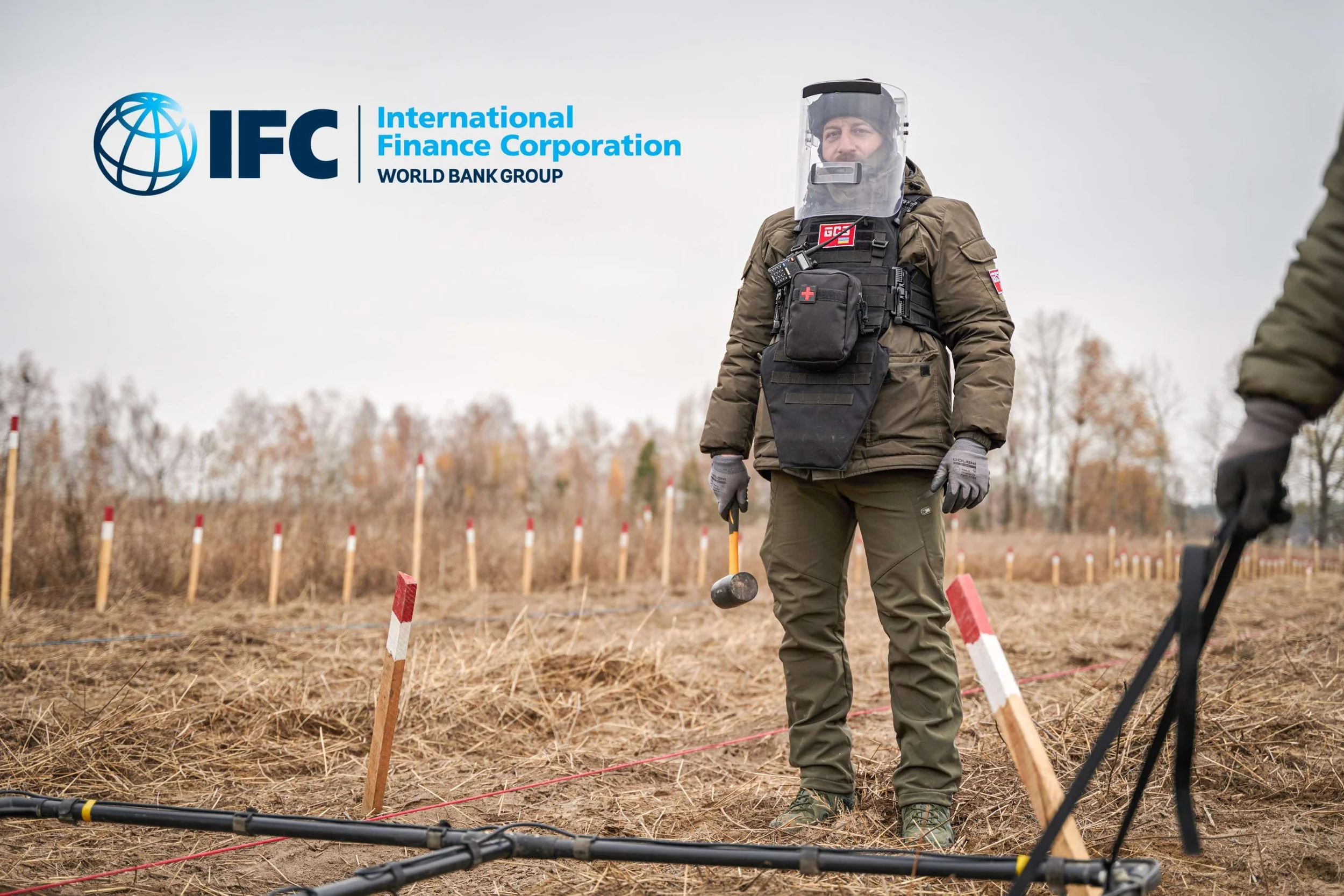
Besides the restoration of mined land in Ukraine being a security challenge, it is a pressing financial and economic one. Without safe access to land, investment, agricultural production and reconstruction cannot proceed.
In April 2025, Global Clearance Solutions (GCS) contributed operational and technical insight to a workshop for financial institutions in Kyiv, jointly organised by the Independent Association of Banks of Ukraine (NABU) and the International Finance Corporation (IFC). The workshop examined financial mechanisms and business models to support the remediation of mined agricultural land in Ukraine.
Linking clearance capability with financial decision-making
GCS was invited to address the workshop on the role of commercial demining companies in developing practical technologies and business solutions that support large-scale land remediation. Drawing on field experience in Ukraine and other post-conflict environments, GCS outlined how clearance capacity, when structured correctly, can be integrated into financing frameworks for recovery.
The discussion highlighted that humanitarian demining is not a standalone activity, but a prerequisite for economic activity, requiring predictable funding, operational accountability and scalable delivery.
Clearance as part of economic recovery
The wider significance of the topic was underlined by Ihor Bezkaravainyi, Deputy Minister of Economy of Ukraine, who emphasised that land remediation is central to recovery planning:
"Financial solutions for the remediation of mined land are more than just about security. They are about economics, partnership and the future."
He noted that Ukraine's state programme to compensate the cost of demining agricultural land has already enabled the clearance of more than 1,300 hectares, and referenced the scale of the challenge ahead. According to the Fourth Rapid Damage and Needs Assessment (RDNA4), humanitarian demining represents an estimated USD 29 billion requirement, covering investment in equipment, logistics, safety and the return of land to productive use.
"Safe land is the basis for economic recovery," Bezkaravainyi added.
Cross-sector collaboration
The workshop brought together public authorities, financial institutions and technical partners to explore how mine action can be aligned with agricultural finance, insurance mechanisms and investment planning. By sharing operational realities from the field, GCS contributed to a more informed understanding of how clearance programmes can be structured to deliver measurable economic outcomes.
The event was organised by IFC, a member of the World Bank Group, in partnership with NABU, GICHD, GCS, Agreena and Teravyn Global SA, with opening remarks from representatives of Ukraine's Ministry of Economy, NABU and IFC.
Supporting recovery through safe ground
GCS's participation reflects its broader engagement in Ukraine, where explosivehazard mitigation is treated as a foundational enabler of recovery rather than a parallel humanitarian activity. By contributing operational expertise to financial and policy discussions, GCS supports the alignment of clearance capacity with the investment frameworks needed to restore agricultural production and livelihoods.
A summary in The Rapid Damage and Needs Assessment Report can be viewed online here.
Country
Ukraine
Publish Date
Product Segments
Capabilities
Demining (Humanitarian Mine Action)


